If you had to choose between only machines or only free weights, what would you pick?
A lot of people have a strong opinion about this.
Machines are sometimes treated like beginner tools. Free weights are often seen as the “real deal”. And sure, I understand where that idea comes from.
But in reality, it is not that black and white.
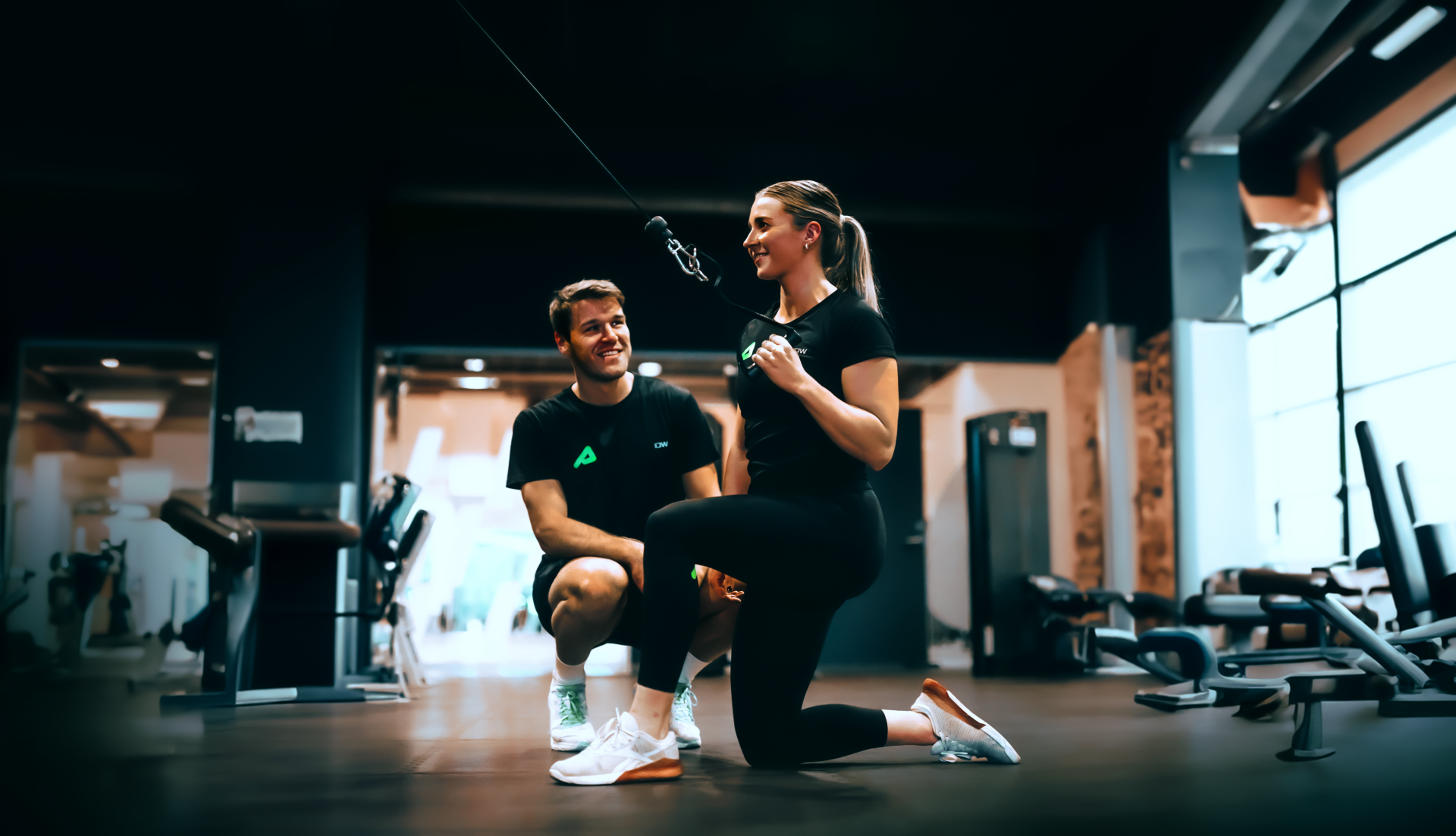
Machines and free weights are just tools. Different tools, for different goals, individuals and scenarios.
Machines can be great when you want to target a specific muscle. They usually require less balance, less coordination and less technical skill. That means the client can often focus more on the muscle they are trying to train.
For a beginner, that can be a huge advantage.
If the goal is to train the quadriceps, a leg extension machine lets you do exactly that. The movement is simple. The target is clear. The exercise is easy to progress.
A squat, deadlift, dumbbell press or lunge usually requires more balance, control and coordination. These exercises often simulate real life movement better.
Standing up. Picking something up. Carrying. Stabilising. Moving your body through space. That can be very valuable. But it also comes with a trade-off.
Take a seated machine shoulder press and compare it with a standing dumbbell shoulder press. The machine version makes it easier to focus on the shoulders. It is stable, simple and easy to load.
The standing dumbbell version demands more from the trunk, the shoulder stabilisers and the rotator cuff.
That can be a good thing. But it can also mean that balance and stability become the limiting factor before the shoulders have received enough stimulus.
So which one is better? Well, that depends on what you are trying to achieve.
This is where coaching matters. A personal trainer should not choose exercises just because they personally like them, or because they look more advanced. The trainer should be able to explain why an exercise fits the client, the goal and the current phase of training.
Let’s take the deadlift as an example. It can be a very effective exercise for building strong glutes, hamstrings and back muscles. But for some people, it may also place more stress on the lower back than they are ready for.In that case, a back extension or reverse hyperextension may be a better choice for now. Not because it is always “better” than a deadlift, but because it allows the client to build strength in a safer environment and through a range of motion they can control.
Or let’s say someone is mainly training to build a stronger, better-functioning body for everyday life. In that case, a standing dumbbell shoulder press may be a great choice. It does not only train the shoulders. It also challenges balance, trunk control and the stabilising muscles around the shoulder.
Again, that does not make it better in every situation. It makes it better for that specific goal, for that specific person, at that specific time.
Good exercise selection is a mix of anatomy, mechanics, experience and common sense. Sometimes the best choice is a machine because it is safe, simple and easy to progress.
Sometimes the best choice is a free-weight exercise because it builds coordination, balance and broader movement skill. And very often, the best programme uses both.
So maybe the better question is not: Machines or free weights?The better question is: What are we trying to achieve, and which tool helps us get there most effectively?